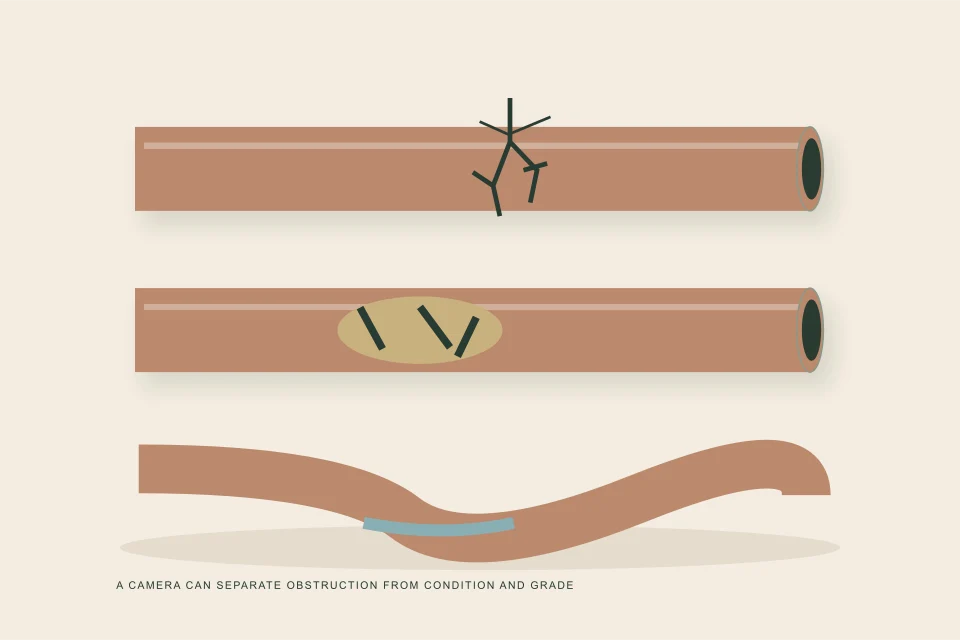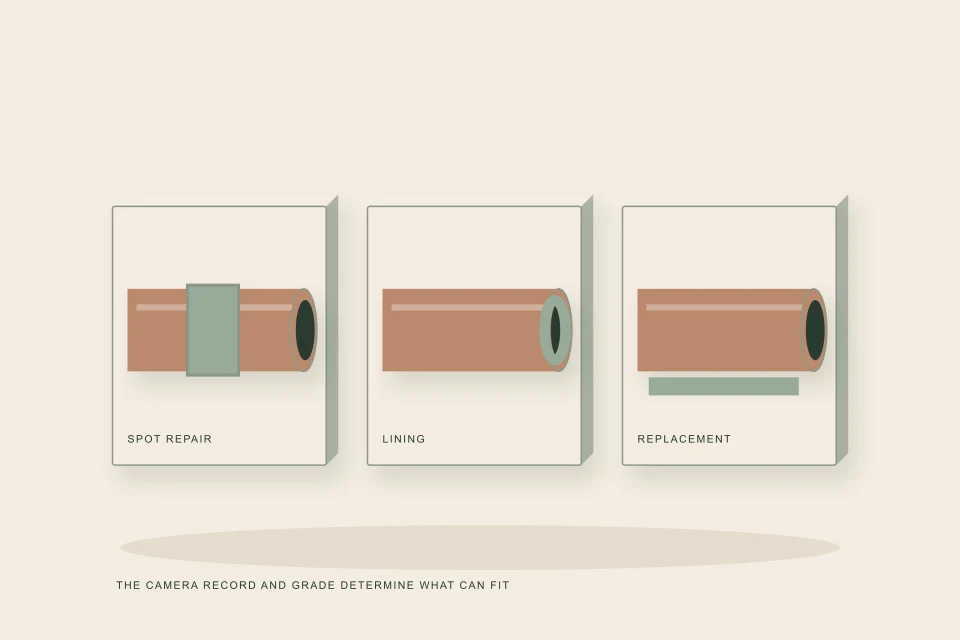
Your options run from cheapest to most thorough: clear and maintain the line, fix one spot (by digging or with a sectional liner), line the whole length from inside (CIPP), burst the old pipe and pull a new one through, or dig a trench and replace the line. The right one depends on what the camera shows, how much of the line it affects, the grade, and what sits on top.
- Match the fix to the defect, not the other way round.
- A liner or a burst follows the old line, so neither can remove a sag; that needs digging at that spot.
- One defect in sound pipe suits a spot repair; defects along the run suit full-length renewal.
- Driveways, trees and landscaping on top push the choice toward trenchless methods.
01 /Can my sewer line be repaired instead of replaced?
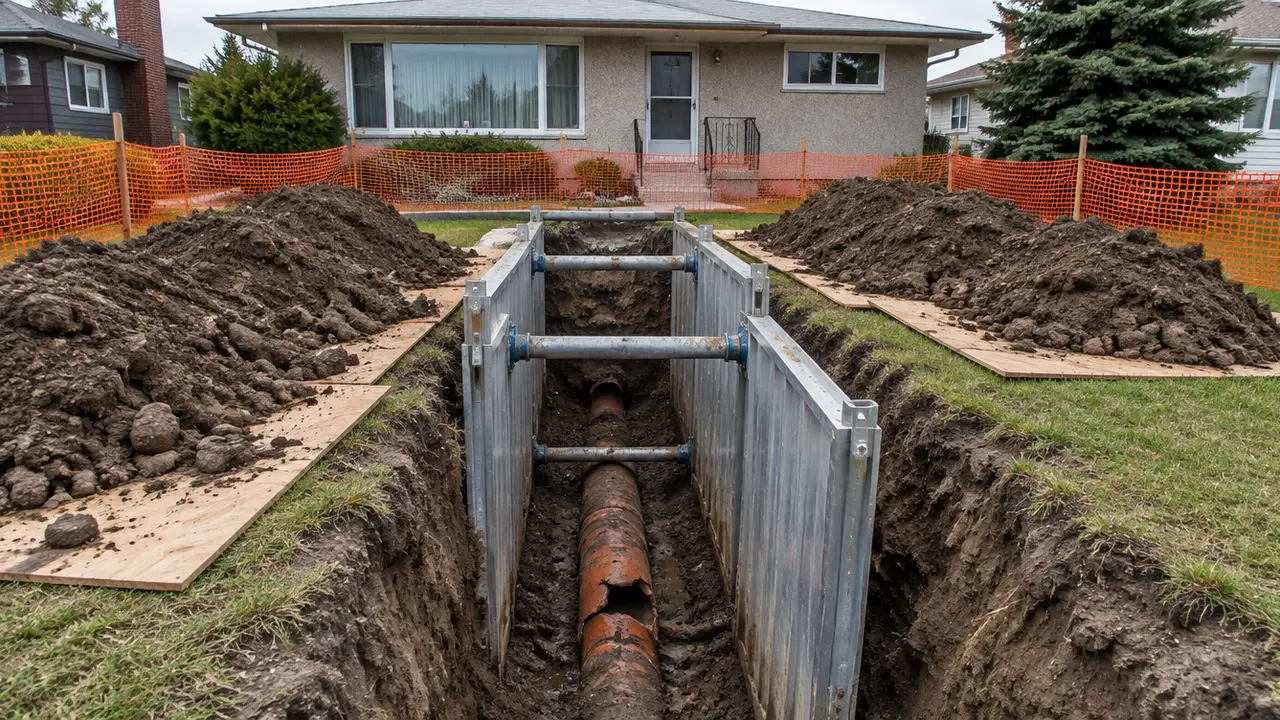
Often, yes. If the camera shows one or two defects in otherwise sound pipe, a spot repair or a short liner renews only those places and leaves the rest alone. Full replacement or full-length lining makes sense when defects repeat along the line, the pipe material is failing everywhere, or earlier repairs keep being followed by new failures somewhere else.
| Option | What it fixes | What it cannot fix |
|---|---|---|
| Clearing and maintenance (cable or jetting) | Blockages, grease, light roots | Any structural defect |
| Spot repair by digging | One short damaged section, including a local sag or collapse | Problems elsewhere on the line |
| Sectional (point) liner | One crack, fracture or leaking joint in pipe still round | A sag, a collapse, a large offset |
| Full-length lining (CIPP) | Cracks, root-prone joints and leaks along the run | A sag; pipe too deformed to line |
| Pipe bursting | Broken or undersized pipe along a fairly straight run; can upsize | A sag; sharp bends; many connections |
| Open-cut replacement | Anything, including grade and route | Nothing structurally, but restoration is the biggest |
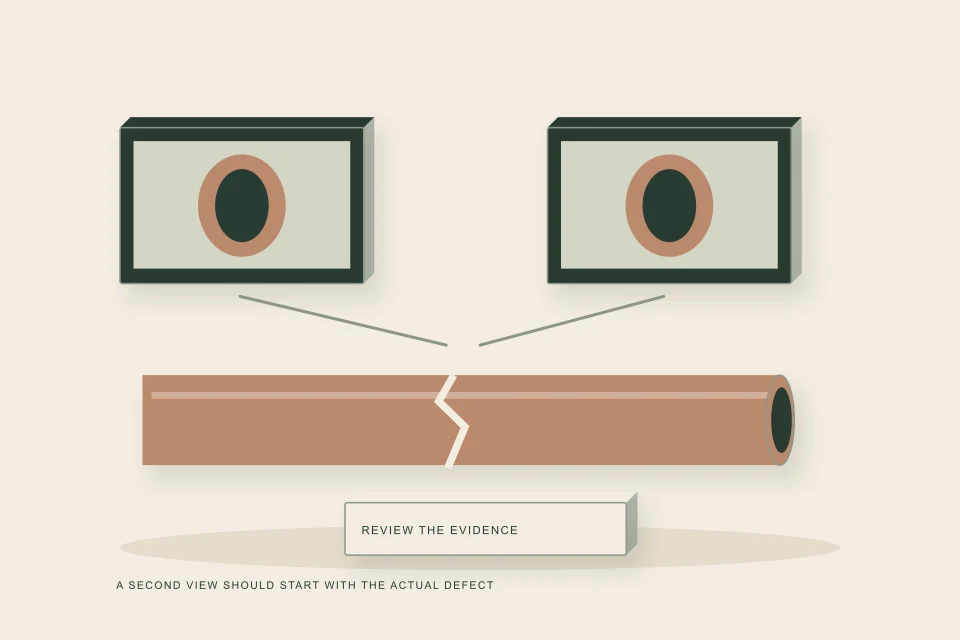
Before deciding, you need a recorded camera run with distances. Getting a second opinion explains how to check what it shows.
02 /When is cleaning enough?
When the pipe is structurally sound and the problem is what is inside it: grease, wipes, scale or a few roots at one joint. Cleaning with a cable or a jetter restores flow, and changes in what goes down the drain keep it clear. If roots return every year from the same joints, or the camera shows the pipe itself is failing, cleaning has become a recurring cost rather than a fix.
Jetting removes grease coatings and root fibres more thoroughly than a cable, which only cuts a path. Sister sites SewerJetting.ca and SewerRoots.ca cover those methods in depth.
03 /What is the difference between a spot repair and a sectional liner?
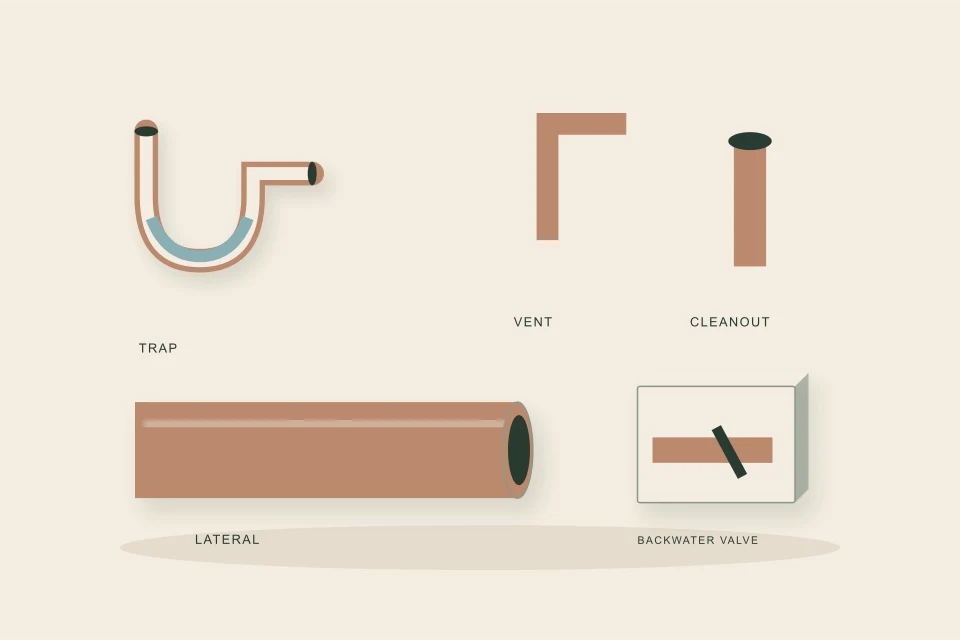
Both fix one place. A spot repair digs down to the defect, cuts out the damaged section and couples in new pipe; it can also correct a local sag, because the new piece is laid on grade. A sectional liner is a short resin-soaked sleeve pressed against the inside of the pipe at the defect and cured there, installed from a cleanout without digging, as long as the pipe is still round and on grade.
Repair-scale trenchless work is the focus of sister site TrenchlessSewerRepair.ca.
04 /How do lining and pipe bursting differ?
Lining builds a new pipe inside the old one; bursting destroys the old one and pulls a new pipe into its place. A cured-in-place liner is inverted or pulled into the cleaned host pipe and hardened, leaving a jointless pipe slightly smaller than the original. Bursting drags a cone through the old pipe, breaking it outward, while new pipe follows; it can install a pipe the same size or larger.
Lining needs a host pipe that still holds its shape and usually needs no pits when there is a usable cleanout. Bursting suits pipe too broken to line and lines that need more capacity, but it needs launch and receiving pits and keeps the old route. Neither changes the grade. The engineering of liners is covered at SewerRelining.ca, bursting at PipeBursting.ca, and every trenchless method side by side at TrenchlessSewer.ca.
05 /When is digging the whole line the right answer?
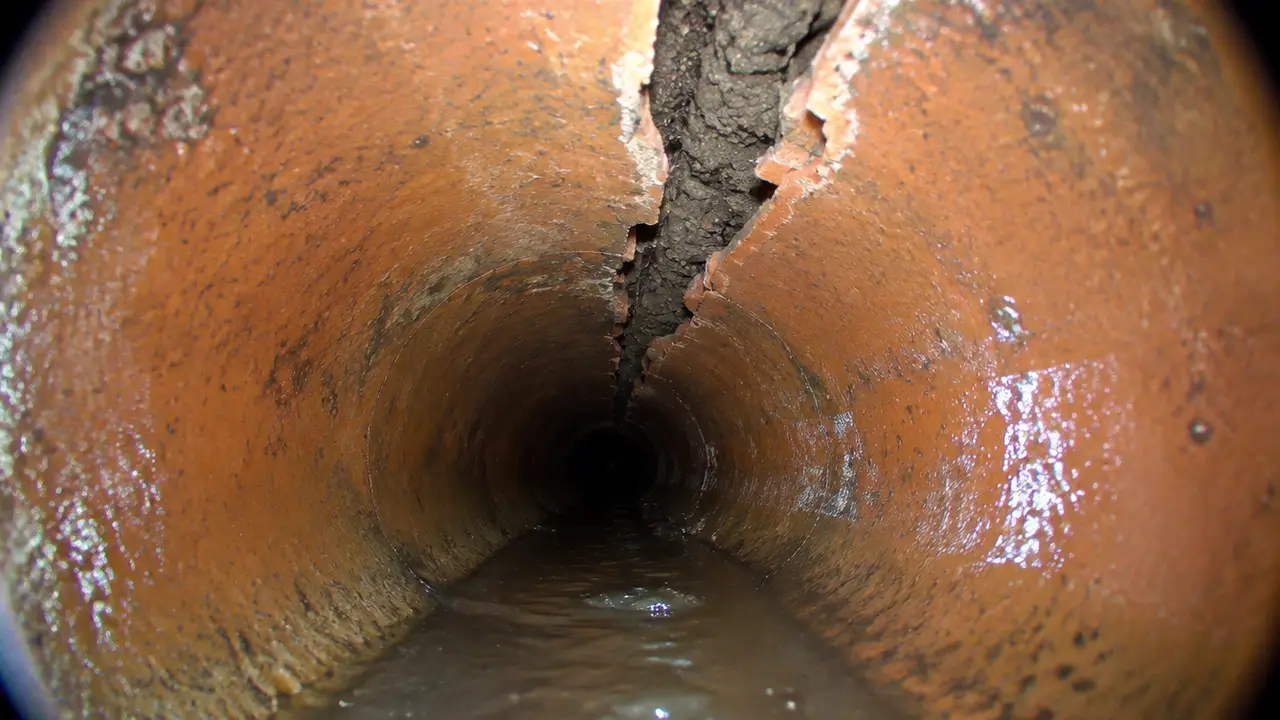
When the grade is wrong along much of the line, when the route has to change, when the pipe has collapsed in several places, or when the line is shallow under open lawn so digging is cheap to restore. Open-cut replacement lays new pipe on new bedding at the correct slope, which no trenchless method can do, and lets the installer see and fix everything.
The trade-offs are restoration and safety. A trench across a driveway, patio or mature trees costs more to put back than the pipe work, and trenches deeper than 1.5 m in Alberta need protection for workers under the provincial OHS Code. Replacement decisions are covered in depth by sister site SewerReplacement.ca.
06 /Can I combine repair methods on one line?
Yes, and it is often the cheapest honest answer. A line rarely fails evenly. A common pattern is a sag near the house, root-prone clay joints across the yard and a sound section near the street. Digging and relaying the sag, then lining the joints from the cleanout, fixes each problem with the method that suits it instead of paying to dig the whole yard or lining over a sag that will keep collecting solids.
- Dig the collapse, line the rest: a collapse must be dug; the round pipe either side can be lined from that pit.
- Spot repair near the house, monitor the rest: when the only defect is one offset and the rest looks sound on camera.
- Line the private side, leave the city side: when the municipality owns and maintains the part past the property line; confirm first.
- Burst the broken section, keep the new plastic: when an earlier repair already replaced part of the run.
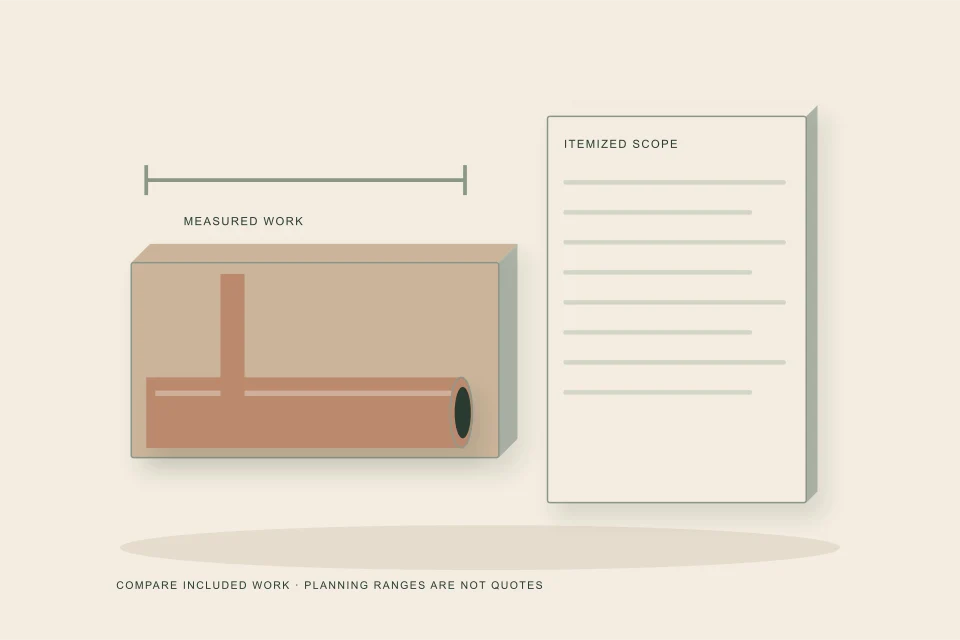
A combined plan needs a clear scope: which length gets which treatment, where each method ends, and how the transitions are sealed. Ask for it on a sketch with distances that match the camera video.
07 /What questions should I ask before choosing a method?
Ask each contractor to explain the method against your video: which defects it fixes, which it leaves, what happens to the grade, how many pits or how much trench, what surface comes back, how branch connections are handled, and what the warranty covers. A contractor who offers only one method for every problem deserves a second opinion from one who offers several.
Then compare the lifetime picture, not just the price: a cheaper spot repair on a line with defects every few metres may be the first of several. Getting a second opinion explains how to test the reasoning, and how to vet a sewer contractor covers the paperwork.
08 /What does each sewer repair option cost?
As 2026 planning estimates in Canadian dollars for a typical house lateral: clearing $200 to $450 per visit, hydro jetting $450 to $1,100, a sectional liner $2,500 to $6,500 for the first defect, an excavated spot repair $3,500 to $16,000, full-length CIPP lining of a 15 to 25 m lateral $9,000 to $28,000, pipe bursting $10,000 to $30,000, and open-cut replacement $12,000 to $35,000 or more.
| Option | Typical quoted range |
|---|---|
| Main-line clearing (cable) | $200–$450 per visit |
| Hydro jetting, residential main | $450–$1,100 per visit |
| Sectional (point) liner | $2,500–$6,500 first section; $1,500–$3,500 each extra on the same visit |
| Excavated spot repair | $3,500–$16,000 |
| Full-length CIPP lining (15–25 m) | $9,000–$28,000 |
| Pipe bursting (15–25 m) | $10,000–$30,000 |
| Open-cut replacement (15–25 m) | $12,000–$35,000+ |
The lowest-cost option is the one that fixes your defect the first time. The cost answers page breaks each range down, and the vetting checklist helps you check the contractor before you sign. To ask which option your video points to, send it to the desk.
FAQQuestions people ask
Can a sewer line be repaired without digging?
Often. Sectional liners, full-length lining and pipe bursting all avoid a continuous trench. They need a round, reasonably straight pipe on grade, and bursting needs pits at each end.
Can lining fix a sagging sewer pipe?
No. A liner takes the shape of the pipe it is in, so a sag stays a sag. The low section has to be dug up and relaid on grade.
How long does a sewer lining last?
Manufacturers and installers commonly state long design lives for CIPP, but actual life depends on installation quality and conditions. Ask for the warranty in writing.
Is it cheaper to repair or replace a sewer line?
Repairing one defect is cheaper when the rest of the pipe is sound. When defects repeat along the run, full-length renewal usually costs less than a series of spot repairs.
NETWORKGo deeper across the HAUSE Sewer network
Trenchless lining vs pipe bursting: cost, fit and trade-offs
Trenchless lining vs pipe bursting cost in Canada: 2026 CIPP and bursting ranges in CAD, line items, which defects each fixes and how to choose.
SewerRoots.caPermanent fixes for roots in sewer lines
Permanent fixes for roots in sewer lines: CIPP lining, sectional point repairs, pipe bursting and open-cut replacement compared by cost, lifespan and fit.
PipeCleaning.caHow long cast iron drain pipes last, and when to repair, line or replace
How long do cast iron drain pipes last? Why they rust and crack, how to judge remaining life, and when a repair sleeve, lining or replacement is right.