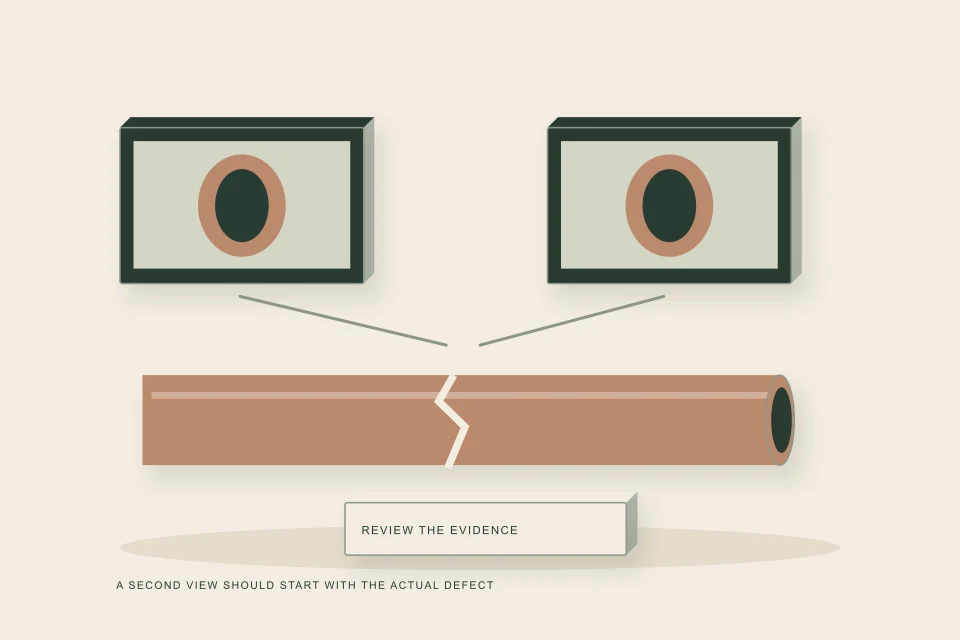
Get a second opinion whenever a sewer recommendation is expensive, urgent-sounding or not backed by a recorded video you have seen: a full replacement after a single clog, a lining job with no defect shown, or a price far from the others. Send the reviewer the video file, the written findings and the quote, not just the verdict. A good diagnosis survives being checked.
- The recording is the diagnosis; without it, nobody else can check anything.
- A second opinion tests each link: symptom, video, finding, location, method and scope.
- Ask the reviewer whether a smaller fix would do the job, and which side of the property line the defect is on.
- Use a reviewer who is not selling the repair, or at least one who quotes the same scope for comparison.
01 /When is a second opinion on sewer work worth it?
When the recommendation costs thousands of dollars, when it was made quickly or under pressure, or when you have not seen the evidence yourself. Sewer diagnoses rest on a camera run that the homeowner often watches for a few seconds on a phone screen. Having another qualified person look at the same recording costs little compared with an unnecessary excavation.
| Situation | Why check it | What to ask |
|---|---|---|
| Full replacement recommended after one clog | One blockage is not proof the whole line has failed | Where exactly are the defects, and how many? |
| No recording offered | Nothing can be verified | Can I have the video file with distances? |
| Lining quoted for a line with a sag | A liner follows the existing grade | Does the video show standing water over a length? |
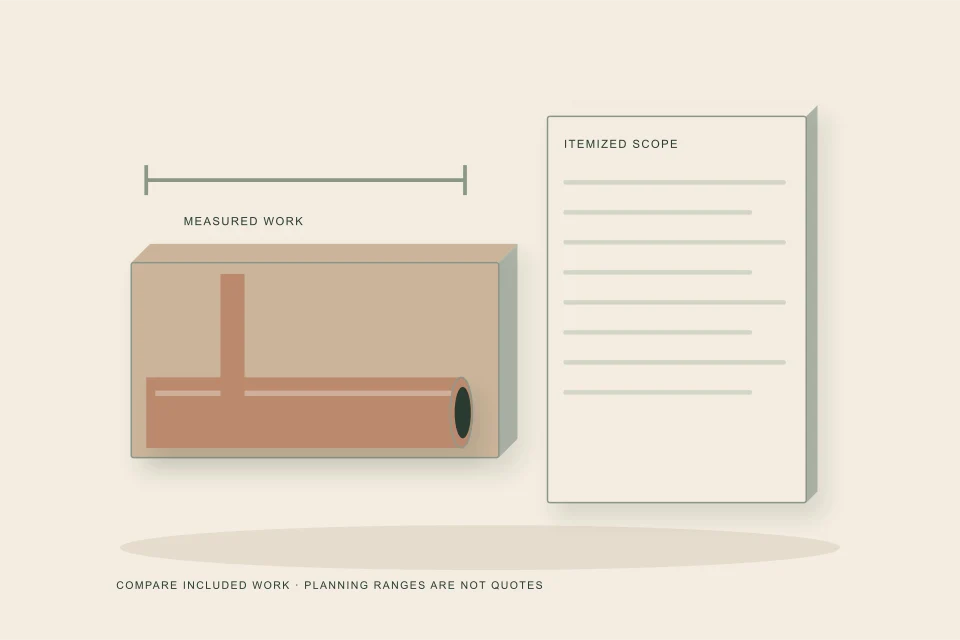
| Quotes differ widely | They may be pricing different jobs | What length, start and end points and access does each assume? |
| "Emergency" replacement at night | Clearing restores flow; repair can wait for daylight | Is the line flowing now? |
| Defect near the property line | Part may be the city's | Which side is it on, measured how? |
02 /What should I send for a second opinion?
Everything the first contractor saw, and the verdict last. The recorded video file of the whole run, the written findings or report, the quote, the address and approximate build year, where the camera went in, and photos of the cleanout and any wet or sunken ground. With those, a reviewer can check the diagnosis rather than just react to it.
- The video file, not a link that expires, with the distance counter visible.
- The written findings: each defect with its distance from the access point.
- The quote, including method, length, access and exclusions.
- The symptom history: what happened, when, and how often.
- Any earlier videos, so the reviewer can see change over time.
03 /How can I check the camera video myself?
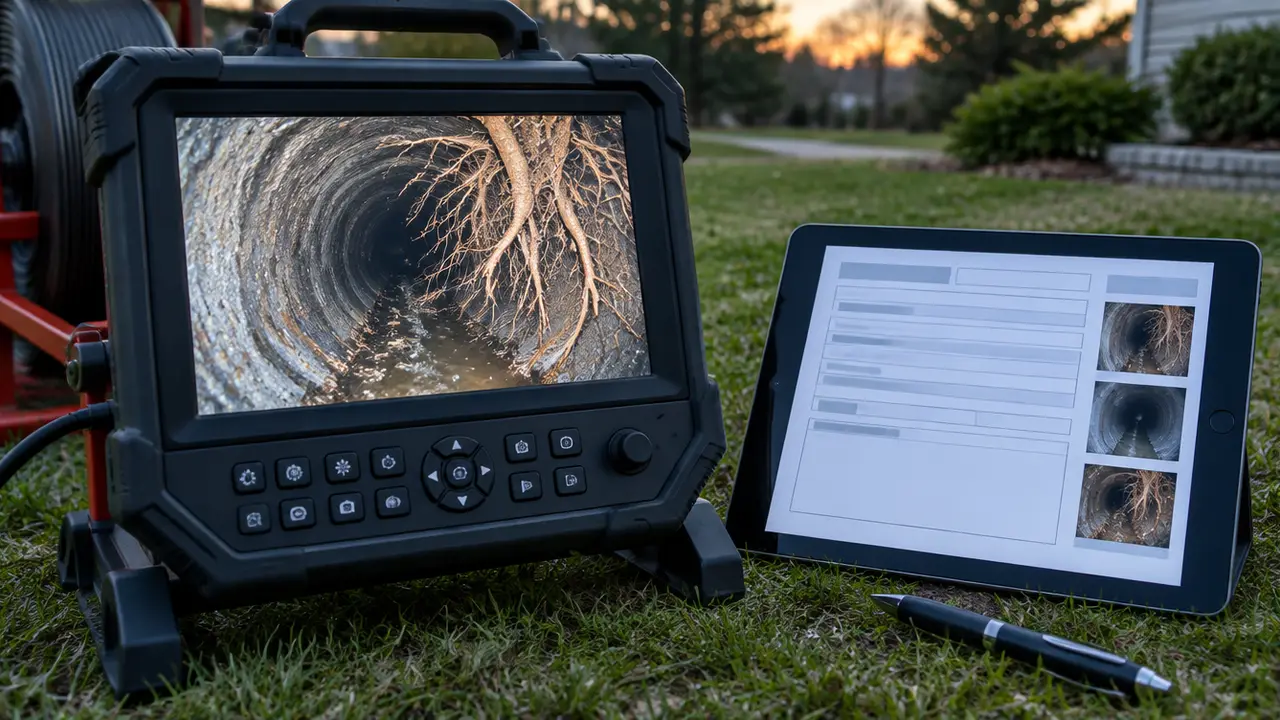
Watch it with the distance counter in view and pause at every finding the quote relies on. You are looking for whether the defect is visible and clear, where it is, and whether it repeats. A crack you cannot see on the screen, or a "collapse" that the camera drives through, deserves questions. So does a recording that stops before the main without explanation.
- Roots: hair-like strands or a mass at a joint. Few strands can be cut; a mat at many joints suggests the pipe joints are open along the run.
- Standing water: a long stretch means a sag; a short puddle at one joint may be minor.
- Offsets: a visible step at a joint. Small ones catch paper; large ones let soil in.
- Cracks and fractures: lines in the wall. Ask whether soil or water is coming through.
- Collapse or missing pipe: soil or rubble in the pipe, loss of round shape. The camera usually cannot pass.
- Material changes: a change from clay to plastic, for example, often marks an earlier repair.
Professional inspectors in North America often code defects using the NASSCO Pipeline Assessment Certification Program (PACP). A report that uses standard codes and distances is easier for anyone to review. Sister site SewerInspector.ca goes deeper on reading footage.
04 /What questions test a sewer diagnosis?
Questions that make the diagnosis explain itself. A sound recommendation answers them easily from the video; a weak one falls back on general claims about old pipes.
- Does the finding explain the symptom?
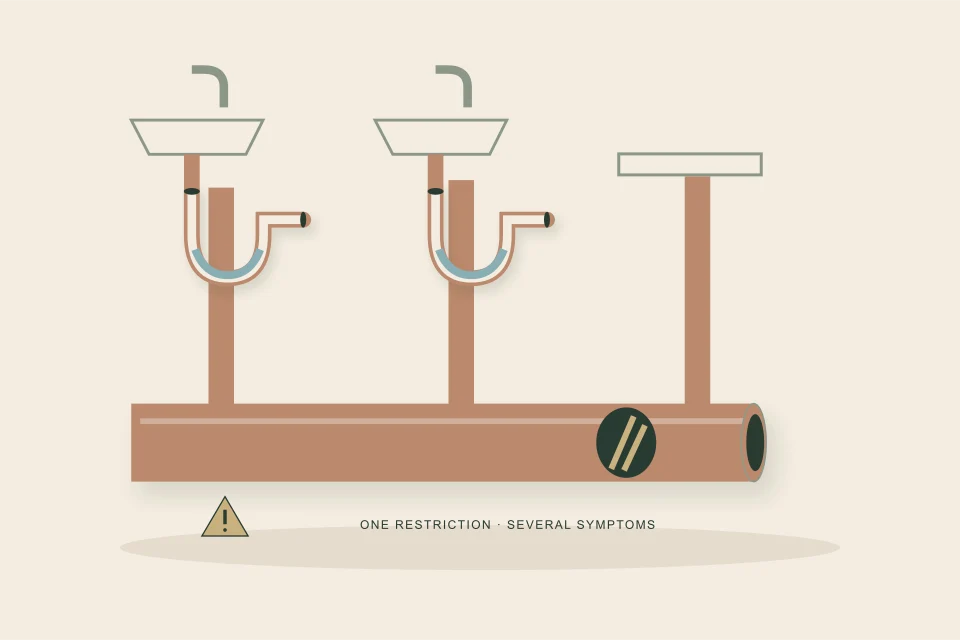
A backup at the floor drain and roots at 14 m fit together. A crack at 3 m with no roots and no standing water may not be what caused the backup.
- Where is the defect, and who owns that section?
Distances from the access point, plus a surface locate, show whether it is under your lawn, your driveway or the city boulevard.
- How much of the line is affected?
One defect suits a spot repair or sectional liner; defects at many joints suggest the whole length.
- Could a smaller fix work?
Clearing and monitoring, a sectional liner, or one dig at the worst spot are cheaper than a full renewal when the rest of the pipe is sound.
- Why this method?
A liner cannot remove a sag; bursting keeps the old route; digging suits shallow lawns. The method should match the defect.
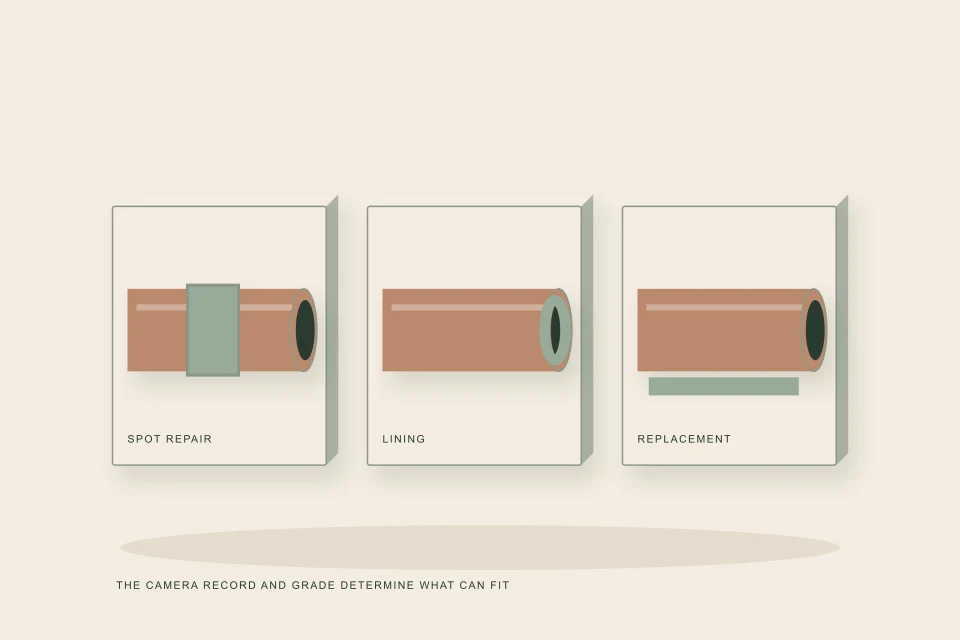
Which method fits which defect is set out in your repair options. Sister site SewerReplacement.ca covers the replacement methods themselves in depth.
05 /Is a second opinion worth it before buying a house?
Yes, and in a different way. Before a purchase there is usually no diagnosis to check yet, so the second opinion is the camera inspection itself, done for you rather than for the seller. A general home inspection looks at visible plumbing; it does not film the lateral. For an older house, a recorded run from inside to the main is the only way to know what is buried under the front yard.
- Book the camera inspection yourself, with an inspector who is not quoting repairs if possible.
- Make sure the camera reaches the main, or find out why it stopped.
- Ask for the video file and a written list of findings with distances.
- If the seller provides a video, have it reviewed before relying on it, and check the date and address on it.
- If defects show up, get a repair quote before the condition deadline so the number can inform your offer.
Planning ranges for inspection and repair are on the cost answers page.
06 /Who should give the second opinion?
Ideally someone with no stake in the repair: an inspector who only films and reports, or a contractor asked to review rather than quote. In practice many homeowners get a second quote instead, which works if you give each contractor the same video and ask them to price the same scope. The comparison then shows whether the first diagnosis holds up.
Tell the second contractor you have a video and want their reading of it before any new camera run. If they want to film again, that is reasonable, especially if the first recording is incomplete, but ask what they expect to learn. If both agree on the findings and differ only on price, you have a pricing decision. If they disagree on the findings, you have learned the most important thing a second opinion can tell you.
07 /What if the second opinion disagrees with the first?
Put the two readings side by side, finding by finding, and ask each contractor to respond to the other's specific points using the video. Disagreements usually come down to a few frames: whether a mark is a crack or a stain, whether water is standing or flowing, whether a defect is at 14 m or 16 m. Those can be settled by pausing the recording together or by a targeted re-inspection at that spot.
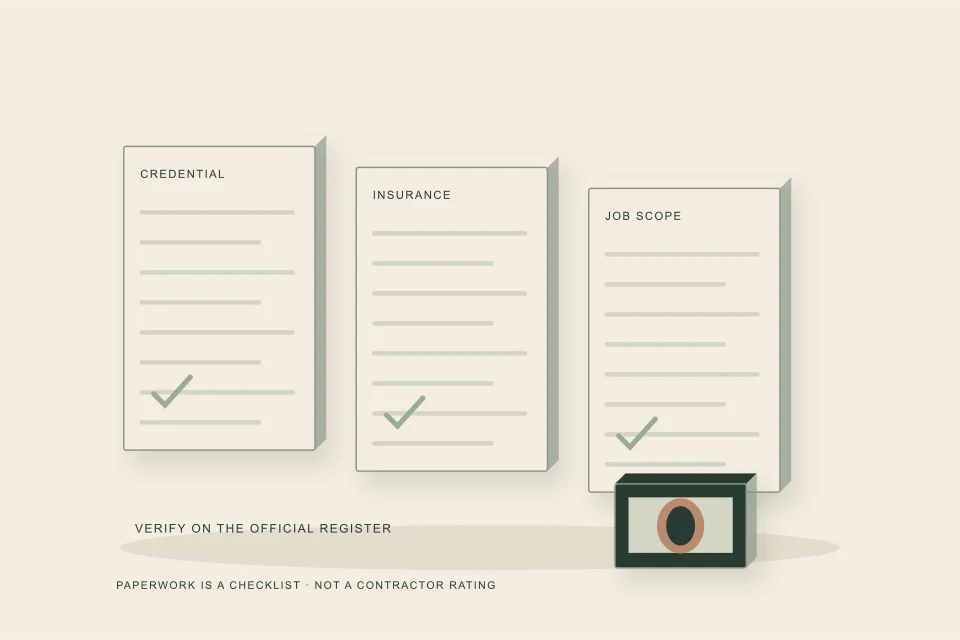
Before you choose, check both contractors the same way with the vetting checklist, and compare the scopes using how to vet a sewer contractor. Planning ranges for each option are on the cost answers page. If you would like the desk to look at a video and quote, send them here.
FAQQuestions people ask
Is it rude to ask for a second opinion on a sewer quote?
No. It is normal for any large repair, and a confident contractor expects it. Asking for the video file is part of the same good practice.
Can I get a second opinion without a new camera inspection?
Yes, if you have the full recorded video with distances. A reviewer can often confirm or question the findings from that alone.
What if the first contractor will not give me the video?
Treat the diagnosis as unverified. Pay for an independent camera inspection before agreeing to any expensive repair.
How do I know which side of the property line a defect is on?
Measure along the pipe from the access point using the video distances, have the spot located on the surface, and compare it with your property line. Ask your municipality where its responsibility starts.
NETWORKGo deeper across the HAUSE Sewer network
Is a sewer scope worth it? When it pays off, and when it doesn't
Is a sewer scope worth it? A plain decision framework: which homes and situations justify one, when it is optional, common objections, and how often to re-scope.
SewerQuotes.comHow to compare sewer quotes line by line
How to compare sewer quotes: a line-by-line worksheet to normalise scope, spot missing items, convert to per-metre cost and choose between three contractor quotes.
PipeCleaning.caPipe Method Matcher: which cleaning methods suit your pipe
Pipe Method Matcher: enter your house era, pipe material and symptom to see which pipe cleaning methods are recommended, safe with conditions, or avoid.