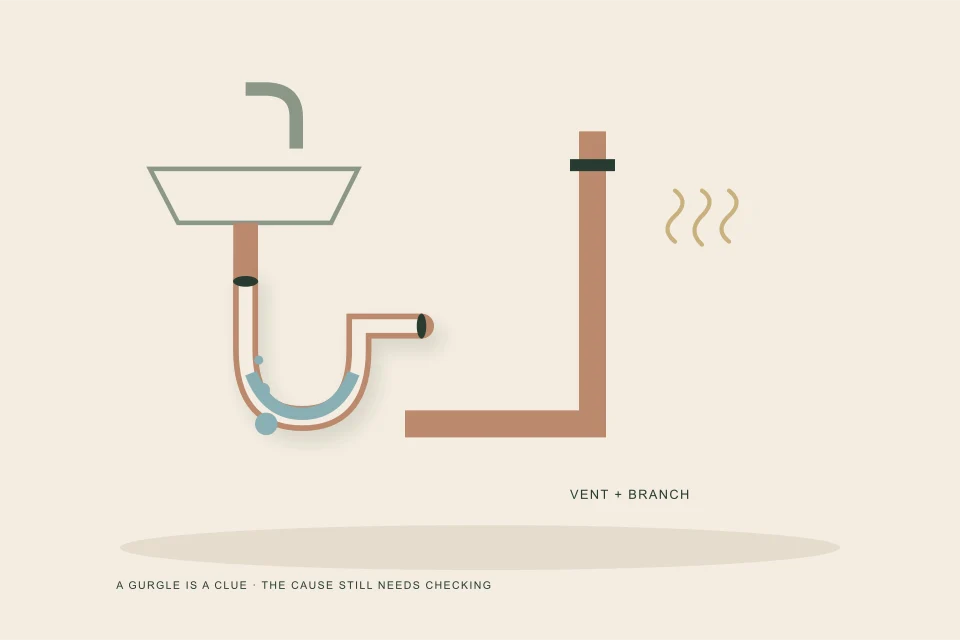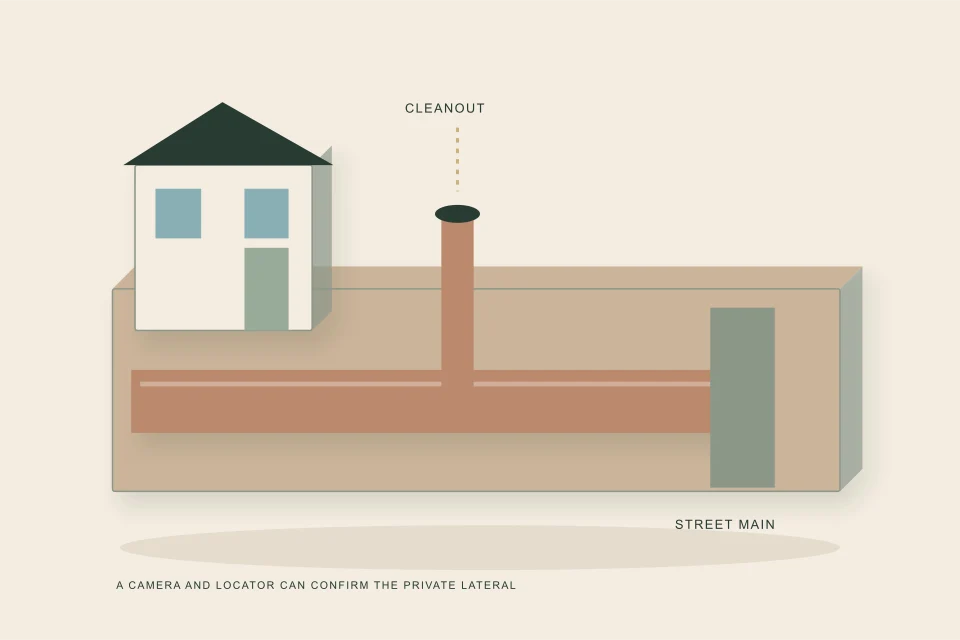
Your main cleanout is usually a capped fitting on the building drain in the basement, near where the sewer leaves through the foundation wall, or on a short riser outside near the foundation. The sewer line runs from that point in a fairly straight, sloping path to the city main, usually under the front yard toward the street or toward a rear lane. A camera with a sonde shows its exact route and depth.
- Look low on the foundation wall that faces the street or lane: the building drain leaves the house there.
- Public locate services mark utility-owned lines only; your private sewer lateral needs a private locator.
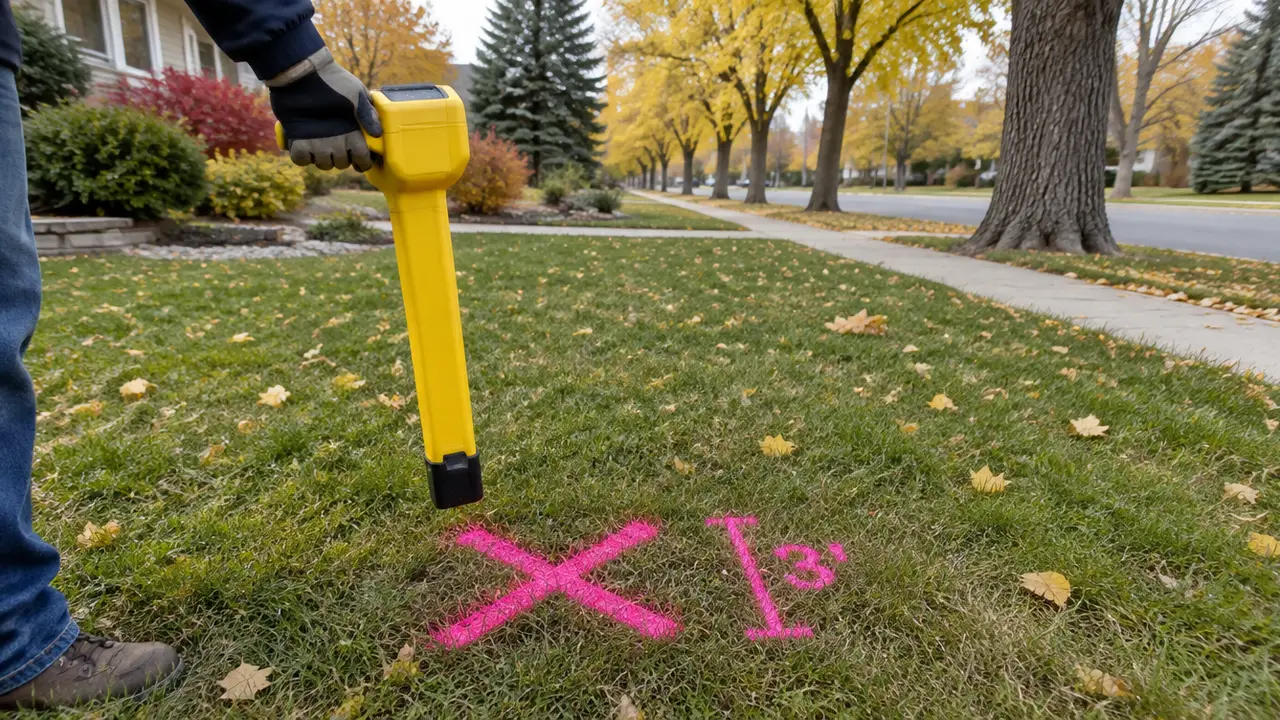
- A camera with a sonde transmitter traces the line and its depth from the surface.
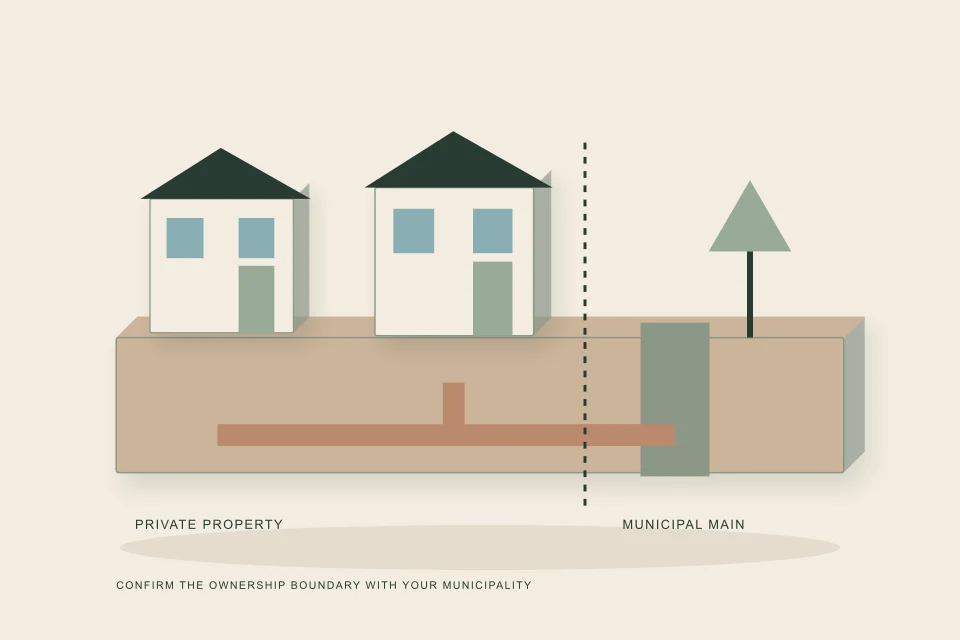
- Ownership usually splits at the property line, but the details vary by city; confirm before paying for work.
01 /Where is my sewer cleanout?
Start in the basement at the wall closest to the street or lane. The main stack drops to the building drain under the floor, and the drain leaves through the foundation there. The main cleanout is usually a round cap, threaded plug or square-headed fitting on the drain near the wall or at the foot of the stack, sometimes set in the floor with a small cover. Outside, look for a capped pipe stub near the foundation on the same side.
| Spot | What it looks like | Notes |
|---|---|---|
| Base of the main stack | A Y-fitting with a threaded cap or plug | Often behind a furnace room wall or in a utility area |
| Basement floor near the front wall | A round cover set flush with the concrete | Can be hidden under flooring or storage |
| Inside the floor drain body | A plug in the side of the drain | Common in some older homes |
| Outside near the foundation | A short capped riser in the lawn or bed | Newer homes and replaced lines often have one |
| Near the property line | A capped riser or small box | Some cities and older installations; confirm locally |
If you cannot find one, a contractor can reach the line by removing a toilet or going down the roof vent, at extra cost. Adding an accessible cleanout is often worth it if you ever need the line cleared or filmed again. City crews expect access too: Calgary asks homeowners to clear about two metres around the cleanout before a crew arrives, and EPCOR notes its crews cannot work in crawl spaces under 5 ft high or smaller than 4 ft by 4 ft.
02 /Where does my sewer line run outside?
Usually in a fairly straight line from where it leaves the foundation to the connection at the city main, sloping down all the way. In most Canadian suburbs the main is under the street in front, so the lateral crosses the front yard. Where there is a rear lane, the main may be in the lane and the lateral runs out the back. The line keeps its slope, so it is deepest at the main.
- The side of the house with the main stack and cleanout is the side the line leaves from.
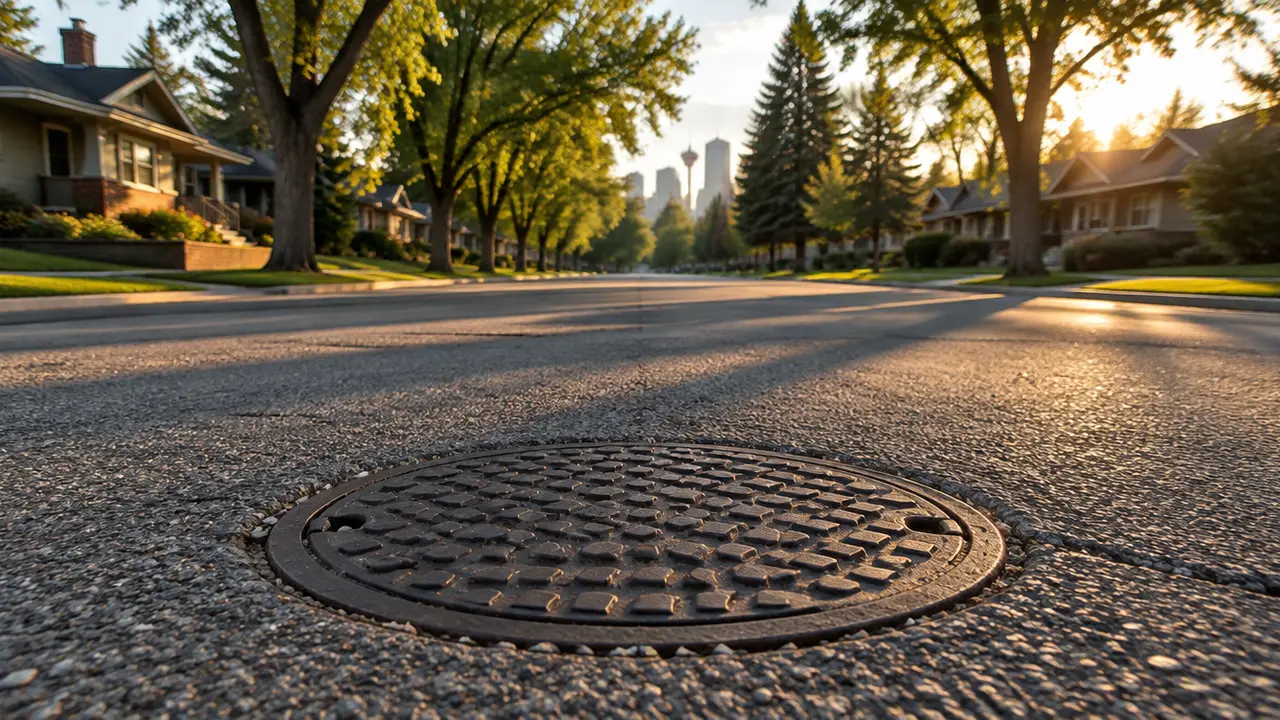
- A manhole in the street or lane in line with your house is a clue to where the main runs.
- Mature trees with vigorous growth between the house and the street sometimes sit over the lateral.
- Your municipality may hold a service record or plan for the connection; ask what it has.
- A camera with a sonde gives the real answer: the locator follows the transmitter from above and marks the route and depth.
03 /Will the one-call locate service mark my sewer line?
Usually not. Provincial locate services mark lines that belong to their member utilities, such as gas, power, communications and many municipal mains. The private sewer lateral and water service on your property are the owner's, and they are not marked. Utility Safety Partners in Alberta and Ontario One Call both say customer-owned sewer lines need a private locator, and BC 1 Call notes that services on private property are generally not identified.
| Province | Service | Notice before digging | Private sewer marked? |
|---|---|---|---|
| Alberta | Utility Safety Partners | At least three full working days | No; hire a private locator |
| British Columbia | BC 1 Call | Members respond within three working days | Generally not |
| Ontario | Ontario One Call | At least five business days | No; private sewer and septic piping is excluded |
Anyone digging, including for a sewer repair, must request public locates first. The contractor usually arranges both the public request and the private locate of your line; the vetting checklist asks you to confirm who does it.
04 /How deep is my sewer line?
Deep enough to stay below frost and to slope down to the main, so it varies by region, lot and house. Near the foundation it is often not far below the basement floor level; by the property line it is deeper, and at the main deeper again. The honest answer for your house comes from a camera sonde reading, which gives depth at each marked point.
Depth matters for three reasons: whether a shallow section can freeze in a long cold spell, how much a dig will cost, and whether a repair needs a shored trench. A contractor quoting a dig should state the depth they expect and where it came from. Planning ranges by depth are on the cost answers page.
05 /Who owns which part of the sewer line?
In most Canadian cities the owner is responsible for the pipe on their own property, and the municipality or its utility for the pipe from the property line to the main. That split is common but not universal. Some municipalities make owners responsible for the whole connection to the main, some share costs by cause, and older agreements can differ. Always confirm with your city before paying for work near the property line.
Two examples as published: Toronto says the City owns the part from the sewer main to the property line and the owner the part from the property line into the home. EPCOR in Edmonton says owners maintain and repair sewer lines on their property, including any backwater valve, and EPCOR is responsible from the property line to the main. More cities are listed on the across Canada page.
06 /Why does it matter what is on top of my sewer line?
Because the surface above the line decides what a repair costs and which methods make sense. A lateral under open lawn can be dug and restored with topsoil and seed. The same pipe under a driveway, a deck, a garage pad or mature trees costs far more to reach and put back, and that is where trenchless methods earn their place. Knowing the route before anything fails lets you plan instead of react.
It also matters for what you build. A new deck, a patio, a retaining wall or a tree planted over the lateral makes every future repair harder and more expensive. Before landscaping or building over the front yard, have the line located and filmed, fix anything the camera finds while access is easy, and keep new trees well away from the route. Sister site SewerRoots.ca covers planting distances.
07 /What should I do once I know where it is?
Write it down. Note where the cleanout is, where the line leaves the house, the route and depths if you had it located, and the date of any camera video. Keep the cleanout accessible and uncovered. It saves time and money in the next emergency and is useful to a buyer when you sell.
If you are looking because something is wrong, the Sewer Symptom Triage will help sort it, and signs the main line is clogged explains what the cleanout can tell you. The words used by contractors are in the glossary. You can also ask the desk for help reading a locate or camera report.
FAQQuestions people ask
What does a sewer cleanout look like?
Usually a capped or plugged fitting on the drain pipe near the foundation wall or the foot of the stack, or a short capped pipe sticking out of the ground outside near the house.
What if my house has no sewer cleanout?
A contractor can reach the line through a toilet flange or roof vent, at extra cost. Installing an accessible cleanout is often worthwhile.
Can I find my sewer line with a metal detector?
Not reliably. Most laterals are clay, concrete or plastic. A camera with a sonde transmitter is the dependable way to trace it.
Why is water coming out of my outdoor cleanout?
The line downstream is blocked or the main is full, so water is escaping at the lowest opening outside. Stop water use and call for clearing.
Does my sewer line run under the driveway?
It often does when the driveway lies between the house and the main. A locate before any dig shows the route and helps price surface restoration.
NETWORKGo deeper across the HAUSE Sewer network
Sewer line locating and depth: how the mark on your lawn is made
How sewer line locating and depth readings work: the sonde, the hand-held locator, peak and null readings, marking, accuracy, and calling before you dig.
SewerCleaners.caWhere is my backwater valve? How to find it, recognize it and open the cover
Where is the backwater valve in a house? How to find it, what it looks like, what access box, sleeve and cover mean, how to open it safely, and valve alarms.
SewerRoots.caWhose tree, whose pipe: who pays when roots block a sewer line
Who is responsible when a city or neighbour's tree sends roots into your sewer line: the general Canadian pattern, the evidence, and how to raise it.